

Date of publication: 19/01/2026
Category: International Policy & Legal Affairs
Prepared by: ESG Expert Team – Carbon Credit Viet Nam Joint Stock Company
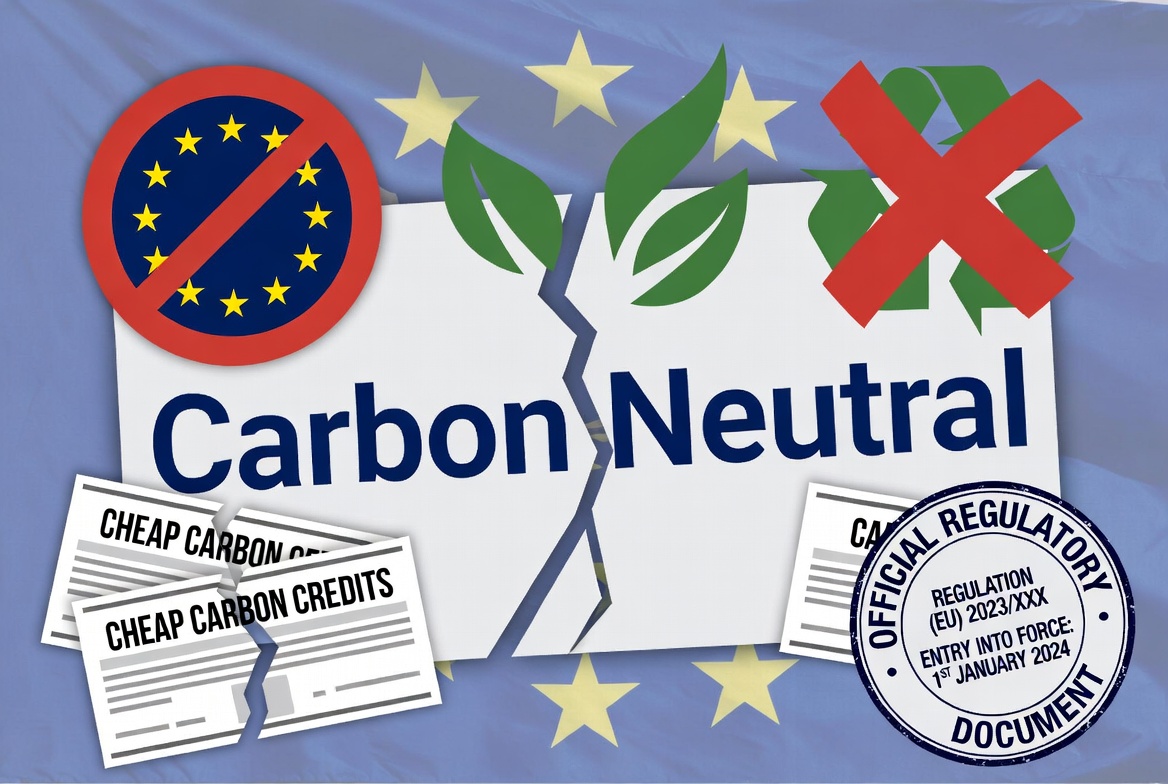
The European Union (EU) has officially put an end to the “pay-to-pollute” era. Under Directive (EU) 2024/825 on Empowering Consumers for the Green Transition (ECGT), starting from 27/09/2026, marketing claims such as “carbon neutral” or “environmentally friendly” will be BANNED if they are based entirely on the purchase of carbon offsetting credits without genuine emission reduction efforts.
This is a seismic legal change, forcing Vietnamese exporters to redesign their packaging and overhaul their entire communications strategy in the European market.
1. CONTEXT: WHEN CONSUMERS LOSE TRUST
Over the past decade, the market has been flooded with products – from water bottles and T-shirts to airline tickets – labeled “Carbon Neutral”. However, most of these claims were made by businesses buying cheap carbon credits (often from low-quality afforestation or renewable energy projects) to “balance out” their emissions on paper, while their actual production processes continued to pollute.
The EU regards this as consumer deception. The new directive is designed to ensure that when someone buys a “Green” product, that product genuinely has a positive impact, rather than being the result of carbon accounting tricks.
2. THE CRITICAL POINTS OF THE NEW DIRECTIVE
2.1. A ban on generic environmental claims
The following terms will be banned from packaging and advertising unless accompanied by excellent scientific evidence:
- “Eco-friendly”
- “Green”
- “Natural”
- “Biodegradable”
- “Climate neutral”
2.2. The “fatal flaw” of the offsetting mechanism
This is the most important change: Businesses are not permitted to claim a product is carbon neutral based solely on offsetting.
- Previously: A business emitting 100 tonnes of CO₂ would buy 100 carbon credits (at $5/credit) => declare itself “Net Zero”.
- From 09/2026: This practice is considered a violation of the law. Businesses must prove they have directly reduced emissions (for example: switching to solar power, upgrading boilers) before they are allowed to speak about their environmental achievements.
3. PENALTIES: NO LONGER JUST A WARNING
The penalties for violating this directive are severe and highly deterrent:
- Fines of up to 4% of the business’s annual turnover in the EU member state where the violation occurred.
- Confiscation of all profits earned from transactions involving the violating product.
- Exclusion from public procurement tenders in the EU for up to 12 months.
4. IMPACT ON VIETNAMESE EXPORTERS
Vietnam’s fast-moving consumer goods (FMCG), food, beverage and textile-garment sectors will bear the most direct impact.
4.1. Labeling Risk
Many Vietnamese businesses currently print “Eco-friendly” or “Green Product” logos on their export packaging indiscriminately. From September 2026, such shipments could be blocked at port or sued by consumer protection organizations in Europe.
4.2. Pressure from real transition costs
Businesses can no longer take the “shortcut” of buying cheap carbon credits. Budgets previously spent on buying credits (Offsetting) must now be redirected toward technology investments that deliver real emission reductions (Insetting). This demands larger capital outlays and longer timeframes.
5. STRATEGIC RECOMMENDATIONS FROM CARBON CREDIT VIET NAM
To adapt to this stringent regulation, we recommend a 3-step action roadmap:
Step 1: Review and “clean up” Marketing (Marketing Audit)
- Immediately review all packaging, websites and product catalogues destined for the EU.
- Remove generic terms such as “Eco”, “Green” and “Neutral” unless backed by a Product Life Cycle Assessment (LCA) certification or verification by a reputable third party.
Step 2: Shift from “Offsetting” to “Contribution”
Instead of claiming “Carbon Neutral” (easily litigated), switch to more modest and accurate claims such as:
- “We have reduced our carbon emissions by 20% compared to 2020” (with supporting data).
- “We fund forest protection projects” (instead of saying those projects make our products carbon neutral).
- This is the “Beyond Value Chain Mitigation” communications strategy now being encouraged globally.
Step 3: Prioritize emission reductions at source (Insetting)
Concentrate resources on greening production processes right at factories in Vietnam. Reducing 1 tonne of CO₂ for real at the factory is now worth 10 times more in brand value than buying 1 tonne of CO₂ from an external project.
6. CONCLUSION
The EU’s new regulation is the necessary “bitter medicine” to cure the disease of hollow achievements in sustainable development. For Vietnamese businesses operating with integrity, this is actually good news: it eliminates unfair competition from rivals who simply “pay for labels”.
Let product quality and real emission reduction data speak for themselves, rather than empty slogans.
About us: This report was prepared by the ESG Strategy & Policy Team of Carbon Credit Viet Nam Joint Stock Company. We partner with businesses to build substantive emission reduction roadmaps and safe ESG communications strategies that comply with international law.